the place versus by which
Associated Articles: the place versus by which
Introduction
With enthusiasm, let’s navigate via the intriguing subject associated to the place versus by which. Let’s weave attention-grabbing data and provide contemporary views to the readers.
Desk of Content material
The Delicate Artwork of "The place" vs. "In Which": Mastering Prepositional Decisions

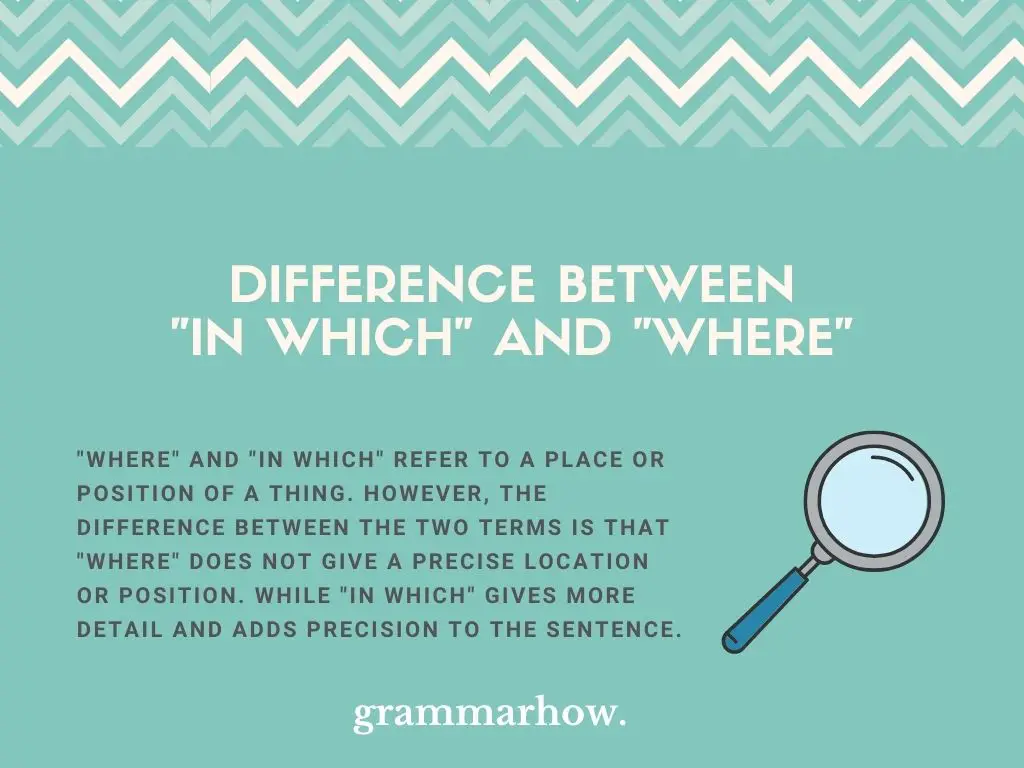
The seemingly insignificant distinction between "the place" and "by which" typically journeys up even seasoned writers. Whereas each prepositions relate to put or location, their applicable utilization hinges on the grammatical construction of the sentence and the nuance of the supposed that means. Understanding this distinction is essential for attaining readability, precision, and a sophisticated writing model. This text delves deep into the intricacies of "the place" versus "by which," providing clear explanations, examples, and steering on selecting the right preposition in numerous contexts.
Understanding the Fundamentals:
"The place" is an easy, easy adverb of place. It signifies location and is often utilized in less complicated sentences to introduce a clause describing a spot. It is readily understood and simply built-in into on a regular basis speech and writing.
"Through which," however, is a extra formal and sophisticated prepositional phrase. It introduces a relative clause, including extra descriptive element a couple of noun that represents a spot. This makes it appropriate for extra advanced sentences requiring a extra refined and nuanced expression.
Key Variations and Utilization:
The core distinction lies in the kind of clause every introduces:
-
"The place" introduces adverbial clauses: These clauses modify the verb of the principle clause, offering details about the situation of an motion or state of being. They reply questions like "the place did it occur?" or "the place is it positioned?"
-
"Through which" introduces adjectival clauses: These clauses modify a noun, offering additional description or specification about that noun, typically a spot. They reply questions like "which place?" or "what sort of place?"
Let’s illustrate this with examples:
Instance 1: Easy Location – "The place"
- "I grew up within the small city the place my grandparents lived."
Right here, "the place my grandparents lived" is an adverbial clause modifying the verb "grew up." It specifies the situation of the motion. Changing "the place" with "by which" would sound awkward and overly formal on this context.
Instance 2: Descriptive Element – "In Which"
- "The museum, by which numerous artifacts are housed, is a major historic landmark."
Right here, "by which numerous artifacts are housed" is an adjectival clause modifying the noun "museum." It supplies further details about the museum’s traits. Utilizing "the place" could be grammatically incorrect and would considerably alter the that means. It could suggest the artifacts are housed in a location close to the museum, not inside it.
Additional Nuances and Issues:
The selection between "the place" and "by which" typically is dependent upon the extent of ritual and the complexity of the sentence. In casual writing, "the place" is usually most well-liked for its simplicity and readability. Nonetheless, in additional formal settings, equivalent to tutorial papers or authorized paperwork, "by which" is perhaps extra applicable to take care of a constant degree of sophistication.
Circumstances the place "In Which" is Most well-liked:
-
Formal Writing: As talked about, "by which" lends a extra formal tone to the writing, making it appropriate for educational papers, authorized paperwork, and different formal contexts.
-
Emphasis on the Noun: "Through which" emphasizes the noun it modifies, highlighting its traits or attributes associated to location.
-
Advanced Sentences: In sentences with a number of clauses or advanced grammatical constructions, "by which" can enhance readability and readability by exactly specifying the connection between the clauses.
-
Avoiding Ambiguity: In some circumstances, utilizing "by which" can eradicate ambiguity which may come up from utilizing "the place." That is very true when the situation is just not a easy, simply identifiable place.
Circumstances the place "The place" is Most well-liked:
-
Casual Writing: "The place" is completely acceptable and even most well-liked in casual writing kinds, equivalent to blogs, private essays, and informal conversations.
-
Easy Sentences: In easy sentences the place the situation is easy and simply understood, "the place" is extra concise and natural-sounding.
-
Emphasis on the Motion: "The place" emphasizes the motion or occasion that occurred at a particular location, quite than specializing in the traits of the place itself.
-
Avoiding Wordiness: Utilizing "the place" could make the sentence extra concise and fewer cluttered, notably when pointless formality is undesirable.
Examples Highlighting the Nuances:
Let’s study extra examples to additional illustrate the refined variations:
-
"Town the place I used to be born is understood for its lovely structure." (Easy, casual, emphasizes the motion of being born)
-
"Town, by which a wealthy tapestry of cultures has flourished for hundreds of years, is a vibrant hub of exercise." (Formal, emphasizes the town’s traits)
-
"The home the place the homicide occurred is now deserted." (Easy, focuses on the occasion)
-
"The home, by which many historic figures as soon as resided, is a nationwide treasure." (Formal, emphasizes the home’s historic significance)
-
"The area the place the earthquake struck continues to be recovering." (Easy, emphasizes the occasion)
-
"The area, by which a fragile ecosystem thrives, is beneath menace from deforestation." (Formal, emphasizes the area’s ecological significance)
Conclusion:
Selecting between "the place" and "by which" requires cautious consideration of the context, model, and supposed that means. Whereas "the place" presents simplicity and readability in most casual settings, "by which" supplies a extra refined and nuanced strategy in formal writing, permitting for a extra exact and detailed description of location and its relationship to the encircling sentence construction. By understanding these refined but important variations, writers can elevate their prose, guaranteeing readability, precision, and a sophisticated remaining product. Mastering this distinction is a testomony to a author’s command of the English language and their capacity to speak successfully and elegantly. Finally, your best option is dependent upon the precise wants of the sentence and the general tone of the writing.



Closure
Thus, we hope this text has offered useful insights into the place versus by which. We hope you discover this text informative and useful. See you in our subsequent article!